Pacuare River Rafting
5.0(94)
Başlangıç
Detayları Gör$119
Natura Eco Park Admission: Wildlife Sanctuary in La Fortuna, Costa Rica
Discover the Wild Side of Costa Rica at Natura Eco Park
Step into a world where rainforest trails, colorful butterflies, fascinating reptiles, tropical birds, and some of Costa Rica’s most remarkable frogs come together in one peaceful natural setting. Located near La Fortuna in the Arenal region of Costa Rica, Natura Eco Park offers an easy and flexible way to experience the country’s extraordinary biodiversity without committing to a strenuous hike or a fixed guided-tour schedule.
The Natura Eco Park Admission: Wildlife Sanctuary is designed for travelers who want the freedom to explore independently. Rather than rushing from one attraction to another, you can follow the park trails at your own pace, stop whenever something catches your attention, take photographs, observe wildlife, and enjoy the tropical surroundings on your own schedule.
This self-guided wildlife experience is especially appealing to families, couples, photographers, first-time visitors to Costa Rica, and nature lovers who want to combine wildlife viewing with a relaxed outdoor activity. The park brings together several carefully designed wildlife areas, including a remarkable frog garden, butterfly garden, snake garden, crocodile lagoon, turtle pond, and rainforest trails.
One of the biggest attractions is the park’s renowned frog garden, where visitors can observe more than 30 species of diurnal and nocturnal frogs and toads. Among the fascinating species you may encounter are glass frogs, red-eyed tree frogs, dart frogs, and other amphibians associated with Costa Rica’s tropical ecosystems. Natura Eco Park describes its frog garden as the largest in Costa Rica, with specially designed modules that recreate habitats where these difficult-to-spot animals can be observed more easily.
But frogs are only the beginning.
As you continue through the sanctuary, you can enter a lush butterfly garden, look for turtles beside the ponds, observe crocodiles and caimans in their lagoon, explore the snake garden, and walk along natural trails surrounded by tropical vegetation. The park also features botanical areas where plants such as heliconias contribute to the colorful rainforest atmosphere and can attract hummingbirds and other wildlife.
Whether you spend a couple of hours exploring the main attractions or take your time enjoying the different habitats, Natura Eco Park provides an accessible introduction to Costa Rica’s extraordinary natural world.
La Fortuna is one of Costa Rica’s best-known destinations for nature, adventure, and wildlife. Located in Alajuela Province near the famous Arenal Volcano, the area is surrounded by rainforest, rivers, waterfalls, hot springs, wildlife habitats, and spectacular volcanic scenery.
For many travelers, visiting La Fortuna means experiencing Costa Rica beyond its beaches. This is a place where the landscape changes quickly from town streets to dense tropical vegetation. The sound of birds can accompany a morning walk, colorful frogs may hide among leaves, and butterflies can move through the vegetation only a few feet away.
Natura Eco Park fits naturally into this environment.
The sanctuary offers visitors an opportunity to appreciate Costa Rican wildlife without needing to undertake a demanding jungle expedition. Its attractions bring together species and habitats that can be difficult to find during a conventional nature walk, making the experience particularly valuable for travelers with limited time in the Arenal region.
The park was established with a strong focus on nature, conservation, education, and the protection of wildlife. Natura Eco Park explains that its history began with the transformation of previously deforested land into a greener environment, followed by the creation of its frog garden. Over time, additional attractions and conservation initiatives were developed, including areas for amphibians and reptiles.
That background gives the experience an additional dimension.
You are not simply entering a collection of animal exhibits. You are visiting a nature-focused environment where wildlife observation, environmental education, habitat recreation, and conservation are important parts of the park’s identity.
Costa Rica is famous for adventure activities, but not every traveler wants an intense experience.
Some visitors want to hike for several hours. Others would rather enjoy nature without steep climbs, technical terrain, or a strict timetable. Parents traveling with young children may need frequent breaks. Older travelers may prefer an activity where they can control the pace. Photographers may want to stop for several minutes at one location while waiting for the perfect moment.
The Natura Eco Park self-guided admission works well for all of these travel styles.
You receive access to the park and can explore according to your own interests. The official park information lists the self-guided admission as a flexible way to access the ecological park and explore its rainforest trails and habitats.
There is no need to feel pressured to keep up with a group.
You can pause beside a pond.
You can spend extra time watching a butterfly.
You can carefully search a frog habitat for a tiny glass frog.
You can photograph the textures and colors of tropical plants.
You can continue when you are ready.
That freedom is one of the strongest advantages of this experience.
For many visitors, the highlight of Natura Eco Park is the frog garden.
Costa Rica is internationally recognized for its amphibian diversity, but seeing frogs in the wild is not always easy. Many species are small, well camouflaged, nocturnal, or hidden among dense vegetation. Even experienced travelers can walk through rainforest trails without noticing an animal that is only a few centimeters away.
The frog garden provides a different opportunity.
Natura Eco Park has created eight specialized modules designed to display more than 30 species of diurnal and nocturnal frogs and toads. The environments are designed to make observation possible while recreating important characteristics of tropical habitats.
This makes the frog garden particularly rewarding for visitors who are curious about Costa Rica’s amphibians but may not have the time, equipment, or experience needed for a dedicated nighttime frog-searching excursion.
One of the most memorable potential discoveries is the glass frog.
Glass frogs are famous for their unusual translucent appearance and tiny size. In a natural rainforest environment, spotting one can be extremely challenging because their coloration and size provide excellent camouflage.
At Natura Eco Park, specially designed habitats make it easier to observe these fascinating amphibians.
This is an excellent opportunity for wildlife enthusiasts to slow down and look closely. Rather than simply walking past the enclosure, take a moment to examine leaves, branches, and shaded areas carefully. Sometimes the most exciting wildlife encounter is not the largest animal in the park but the smallest creature you almost missed.
The red-eyed tree frog is one of the most recognizable amphibians associated with Costa Rica.
Its striking appearance has made it an iconic symbol of tropical wildlife, and seeing one in person can be a highlight for first-time visitors.
The frog garden also provides opportunities to learn about colorful dart frogs and other fascinating species. Natura Eco Park specifically highlights the red-eyed tree frog and black-and-green dart frog among the species visitors may observe.
For families, this section of the park can turn a simple walk into an educational experience. Children can learn how frogs differ in appearance, habitat, behavior, and survival strategies while developing a greater appreciation for tropical ecosystems.
After exploring the amphibian habitats, continue into another completely different environment: the butterfly garden.
The transition can feel almost magical.
Instead of searching for tiny frogs among carefully recreated habitats, you enter a tropical space where butterflies move through the air around vegetation, streams, and waterfalls.
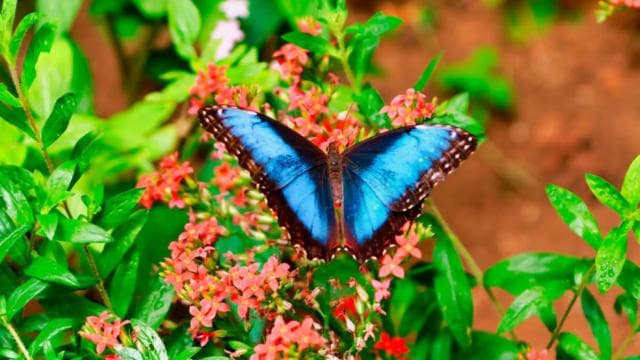
Natura Eco Park’s butterfly garden includes a free-flight area of approximately 980 square meters and reaches around 15 meters in height. The garden features around 20 regional butterfly species, including the owl-eye butterfly and blue morpho.
Butterflies are not simply beautiful to look at. Their movement can make them surprisingly challenging to photograph.
One moment a butterfly may land on a flower.
The next moment it may disappear behind a leaf.
Then, suddenly, several colorful wings may move through the sunlight at once.
The butterfly garden gives you time to appreciate this behavior without rushing.
For photographers, the garden provides opportunities to experiment with close-up images, natural-light photography, wing patterns, flowers, and tropical vegetation.
For families, it offers an engaging introduction to insects and pollination.
For couples, it creates a peaceful and visually beautiful part of the day.
And for travelers who simply enjoy being surrounded by nature, it is a place where you can slow down and enjoy the atmosphere.
The park recommends visiting the butterfly garden earlier in the day, when sunlight begins warming the area and butterfly activity is often greater.
This is useful to keep in mind when planning your visit.
Arriving earlier can also give you more time to explore the park before the heat and humidity become more noticeable.
Costa Rica’s wildlife is not limited to frogs and butterflies.
The country is home to an impressive range of reptiles, and Natura Eco Park provides visitors with opportunities to observe several of them in dedicated areas.
The experience includes access to the snake garden, crocodile lagoon, and turtle pond.
These attractions offer a different perspective on rainforest biodiversity because reptiles often have very different behaviors from the colorful and active creatures visitors may first notice.
For some travelers, snakes are fascinating.
For others, they are intimidating.
Either way, the snake garden provides an opportunity to learn about these important members of Costa Rica’s ecosystems from a safe viewing environment.
The park recreates natural habitats for several snake species, allowing visitors to observe them without entering their environment or searching through dense rainforest vegetation.
This makes the experience particularly useful for families and travelers who want to learn about reptiles without undertaking a specialized wildlife excursion.
Take your time as you move through the area and pay attention to the differences between species. Their patterns, colors, body shapes, and behaviors reveal how different reptiles have adapted to life in tropical environments.
Few animals create the same immediate sense of prehistoric fascination as crocodiles.
At Natura Eco Park, visitors can observe crocodiles and caimans in the crocodile lagoon.
The park highlights the American crocodile, Crocodylus acutus, as well as caimans. The lagoon provides an opportunity to observe these powerful reptiles from a safe perspective and appreciate their adaptation to aquatic environments.
Look carefully across the surface of the water.
Sometimes the animals may appear almost motionless.
That stillness is part of what makes the encounter fascinating. Crocodilians can remain remarkably still while observing their surroundings, making them easy to underestimate until you consider their size and strength.
For children, the crocodile lagoon can be one of the most memorable stops in the park.
For photographers, reflections on the water and close views of the animals can provide interesting compositions.
For nature lovers, the lagoon is another reminder that tropical ecosystems are shaped by creatures both beautiful and formidable.
The turtle pond offers a quieter contrast to the crocodile lagoon.
Turtles have a completely different presence. Their slow movements and ancient evolutionary history make them fascinating subjects for observation.
Natura Eco Park explains that its turtle areas include freshwater species such as white-lipped mud turtles, painted wood turtles, brown wood turtles, black river turtles, and snapping turtles.
This part of the sanctuary is particularly enjoyable for families.
Children can watch the turtles move through the water, rest along the edges, or interact with their surroundings while learning how freshwater reptiles live.
The pond also provides a natural pause in the experience. After walking through several attractions, you can slow down, sit or stand nearby, and simply observe.
The wildlife gardens are only part of the Natura Eco Park experience.
The natural trails allow you to experience the greenery and atmosphere that make the Arenal region so special.
As you walk, look beyond the obvious attractions.
Notice the layers of vegetation.
Listen for birds.
Watch the movement of insects.
Look at the shapes of leaves and tropical flowers.
Observe how light changes as it passes through the canopy.
A rainforest experience is often about more than spotting a particular animal. It is about understanding that thousands of small interactions are taking place around you.
Natura Eco Park’s natural trails pass through lush tropical vegetation and a biodiversity-rich environment.
That makes the walking portion an important part of the overall experience rather than simply a route between exhibits.
Wildlife often gets all the attention, but plants are equally important to the rainforest ecosystem.
During your walk, you can encounter tropical vegetation and garden areas that add color and texture to the surroundings.
The park’s Heliconias Garden is particularly attractive, with plants known for their elongated leaves and colorful flower structures. These plants can also attract hummingbirds and other pollinators.
For photography enthusiasts, tropical plants provide endless opportunities.
Close-up details of flowers can contrast beautifully with wide shots of rainforest greenery. Bright colors stand out against deep green foliage, while water droplets after rain can create additional visual interest.
If you enjoy nature photography, do not focus exclusively on animals. Some of the best photographs from a Costa Rican rainforest experience can come from the vegetation surrounding you.
One of the biggest advantages of Natura Eco Park is its broad appeal.
Families with children can enjoy the variety of animals and colorful environments.
Couples can explore the park together without the pressure of a fixed group itinerary.
Solo travelers can spend as much time as they want at their favorite attractions.
Older travelers can enjoy a nature experience without committing to an extreme adventure.
Photographers can pause whenever they see an interesting subject.
Nature lovers can simply enjoy the surroundings.
The self-guided format is particularly valuable because everyone can experience the park differently.
A child might spend ten minutes watching turtles.
A wildlife enthusiast might spend much longer searching for a glass frog.
A photographer might return to the butterfly garden several times.
A couple might prefer to walk slowly along the rainforest trails.
There is no single correct way to experience Natura Eco Park.
A trip to La Fortuna often includes several major activities. Travelers may visit Arenal Volcano viewpoints, explore rainforest trails, relax in hot springs, visit waterfalls, take rafting trips, or enjoy adventure activities.
Natura Eco Park offers something different.
It is a calmer wildlife-focused experience that can complement a more active Costa Rica itinerary.
If your morning includes an intense adventure, a self-guided wildlife visit can provide a more relaxed afternoon.
If your schedule is packed with excursions, the flexible nature of the admission allows you to plan your visit around the rest of your vacation.
And if you are traveling with people who have different activity preferences, the park can be an easy option because it does not require everyone to participate in a strenuous adventure.
Perhaps the most important feature of this admission is freedom.
A traditional guided excursion follows a predetermined schedule. You meet the guide, begin the route, stop at designated points, and continue with the group.
That can be excellent for travelers who want expert interpretation and structured sightseeing.
But sometimes you simply want to explore.
With the self-guided Natura Eco Park experience, you can create your own rhythm.
Spend more time where you are most interested.
Move quickly through areas that are less important to you.
Stop for photographs.
Take a break.
Continue when you are ready.
The official Natura Eco Park website describes the self-guided admission as a customizable experience that allows visitors to explore the ecological park at their own pace.
That flexibility is especially valuable during a vacation, when every traveler has different energy levels and interests.
Costa Rica’s tropical environment is famous for its rain.
For many travelers, that is part of the adventure.
Rain can transform the rainforest into an even more atmospheric environment. Leaves become glossy, streams become more noticeable, and the smell of wet vegetation fills the air.
Because Natura Eco Park includes covered and specialized wildlife areas alongside outdoor trails, the experience can remain enjoyable when weather conditions change.
A light rain shower does not necessarily mean the day is ruined.
In fact, some travelers may discover that a wet rainforest feels even more authentic.
This is one reason the experience works well as a flexible addition to a La Fortuna itinerary.
Instead of worrying about whether every minute of the day will be sunny, you can embrace the tropical environment as it comes.
A wildlife sanctuary rewards patience.
The best experience does not always come from rushing from one attraction to another.
Pause.
Look carefully.
Listen.
You may notice a bird that another visitor misses.
You may spot a butterfly resting on a flower.
You may discover a tiny frog hidden among vegetation.
You may see a turtle emerge from the water.
You may notice movement in the crocodile lagoon that initially looks like a floating branch.
These moments create the real sense of discovery.
Natura Eco Park is not simply about checking attractions off a list. It is about giving yourself enough time to observe the natural world.
If your idea of a Costa Rica vacation includes wildlife, rainforest scenery, colorful plants, and peaceful outdoor experiences, Natura Eco Park deserves a place on your itinerary.
The park combines several wildlife experiences in one destination, making it possible to see frogs, butterflies, snakes, turtles, crocodiles, caimans, and tropical plants during a single visit.
That variety is one of its greatest strengths.
You do not have to choose between a frog experience and a butterfly experience.
You do not have to choose between reptiles and rainforest scenery.
You can explore all of them in one flexible visit.
Costa Rica is one of the world's most celebrated destinations for biodiversity, and a visit to Natura Eco Park provides a compact way to appreciate some of that natural richness.
Every habitat tells a different story.
Frogs are closely associated with humid tropical environments and play important roles in ecosystems.
Butterflies are important pollinators and are also sensitive indicators of environmental conditions.
Turtles have developed specialized adaptations for freshwater environments.
Crocodiles and caimans demonstrate the power of aquatic predators.
Snakes occupy a range of ecological niches.
Birds and insects connect different parts of the ecosystem through feeding, pollination, and reproduction.
Plants provide shelter, food, and structure for countless species.
When you walk through Natura Eco Park, these individual attractions become pieces of a much larger ecological story.
You do not need to be a professional wildlife enthusiast to enjoy this experience.
You do not need advanced knowledge of biology.
You do not need expensive camera equipment.
You simply need curiosity.
That is what makes a self-guided wildlife sanctuary experience so appealing.
You can arrive knowing very little about Costa Rican frogs and leave having discovered species you never knew existed.
You can enter the butterfly garden simply because it looks beautiful and leave with a better understanding of tropical insects.
You can approach the turtle pond with children and turn a casual stop into an educational moment.
You can observe crocodiles from a safe viewing area and gain a greater appreciation for these ancient-looking reptiles.
Bring your camera or smartphone.
Natura Eco Park offers plenty of opportunities for nature photography.
The butterfly garden is ideal for colorful close-ups.
The frog garden can challenge you to capture small animals in detailed habitats.
The crocodile lagoon provides opportunities for reflections and wildlife portraits.
Tropical flowers and vegetation create natural backgrounds.
Rain can add atmosphere and texture.
For the best results, avoid rushing.
Wildlife photography is often about patience rather than equipment. Watch the animal, anticipate movement, and be ready when the moment arrives.
A simple photograph of a red-eyed tree frog, blue morpho butterfly, or crocodile can become one of the most memorable images from your Costa Rica trip.
There are many ways to experience Costa Rican nature, but Natura Eco Park combines several advantages into one accessible experience.
You control the pace rather than following a strict group schedule.
Frogs, butterflies, snakes, turtles, crocodiles, caimans, birds, and tropical plants create a diverse experience.
The variety of attractions gives children plenty to discover.
You can enjoy rainforest surroundings without committing to a demanding adventure.
The carefully designed habitats make close observation and photography possible.
The experience encourages visitors to learn more about Costa Rica’s wildlife and conservation.
Natura Eco Park is located in the La Fortuna area, making it an easy wildlife-focused addition to an Arenal vacation. The park’s published location is in La Palma, La Fortuna, Alajuela Province, Costa Rica.
If you have limited time, make sure the frog garden is on your priority list.
The combination of more than 30 frog species, specialized habitats, and opportunities to see species such as glass frogs and red-eyed tree frogs makes this one of the most distinctive elements of the park.
Take your time.
Look at the habitat rather than only looking for movement.
Ask children to see who can spot a frog first.
Compare the different colors and patterns.
Think about how easily these animals might disappear into a real rainforest.
This simple activity can turn the visit into a memorable wildlife-searching adventure.
The butterfly garden offers a completely different mood.
Here, movement is constant.
Wings flash through the vegetation.
Some butterflies fly close to the ground while others move through higher sections of the free-flight space.
Sunlight catches their colors.
The environment feels bright, tropical, and peaceful.
The garden’s scale and tropical vegetation make it more than a simple viewing area. It is designed to create an immersive environment where visitors can observe regional butterfly species moving through a lush habitat.
This is a particularly good stop for travelers who enjoy photography or peaceful nature experiences.
One of the best ways to enjoy Natura Eco Park is to avoid treating it like a checklist.
Instead, create your own small adventure.
Begin with the attractions that interest you most.
Walk slowly through the rainforest.
Look for wildlife.
Stop whenever something catches your eye.
Take photographs.
Read about the animals.
Watch how other visitors react to their discoveries.
Then continue exploring.
Because the experience is self-guided, you can adapt your visit as the day unfolds.
If the butterfly garden fascinates you, stay longer.
If your children become fascinated by turtles, give them time to watch.
If you enjoy reptiles, spend more time around the snake and crocodile areas.
If you simply want a peaceful walk surrounded by tropical vegetation, follow the natural trails at an easy pace.
La Fortuna is an adventure destination, but a great vacation should not feel like one long race.
After ziplining, rafting, hiking, canyoning, or exploring waterfalls, the body may appreciate something gentler.
Natura Eco Park provides that balance.
It allows you to remain outdoors and surrounded by nature while choosing how much physical effort you want to invest.
You can walk.
Observe.
Photograph.
Rest.
Continue.
That balance can make the experience especially valuable for families and multi-generational groups.
A visit to Natura Eco Park can also encourage a deeper appreciation of conservation.
The park identifies itself as a conservation-focused organization and explains that it supports the protection of endangered species and natural ecosystems. It also operates as a rescue center and biological station, with initiatives involving amphibians and reptiles.
This context can make the wildlife encounters more meaningful.
Instead of seeing an animal only as a photograph opportunity, visitors can think about why habitat protection matters and why some species are difficult to observe in the wild.
For children especially, these experiences can help turn abstract environmental lessons into something tangible.
They can see the animals.
They can learn about their habitats.
They can understand that biodiversity needs protection.
And they can leave Costa Rica with a greater appreciation for the natural world.
A comfortable visit begins with appropriate preparation.
Closed-toe walking shoes are recommended because you will be exploring outdoor trails and natural areas.
Wear comfortable clothing suitable for warm, humid rainforest conditions.
A light rain jacket or umbrella is useful because tropical weather can change quickly.
Insect repellent can make outdoor walking more comfortable.
Bring drinking water to stay hydrated.
And if wildlife photography is important to you, bring a camera or binoculars.
The goal is not to overpack.
You simply want to be comfortable enough to slow down and enjoy the environment.
La Fortuna can be warm and humid, so lightweight and comfortable clothing is generally a good choice.
Choose breathable clothing that allows easy movement.
Closed-toe shoes are particularly useful for walking the natural trails.
A light waterproof layer can also be valuable.
Most importantly, dress for comfort rather than appearance.
You are visiting a rainforest environment, not a formal attraction.
Comfort will help you spend more time enjoying the park.
The most rewarding wildlife experiences often contain an element of uncertainty.
You may know which attractions you want to visit, but you do not know exactly what you will notice.
That is part of the fun.
You might enter the frog garden looking for a glass frog and discover a different species first.
You might walk through the butterfly garden expecting one type of butterfly and encounter another.
You might pause at the turtle pond and notice an unexpected movement in the water.
You might see crocodiles resting quietly in the lagoon.
You might hear birds while walking through the vegetation.
These small surprises create memories that are difficult to reproduce through photographs alone.
Traveling with children can make activity planning complicated.
Long hikes can be exhausting.
Highly structured tours may be difficult if children need breaks.
Some adventure activities have minimum age or physical requirements.
Natura Eco Park offers a more flexible alternative.
Children can explore different attractions and encounter animals of different sizes, colors, and behaviors.
The variety also helps maintain interest.
If one child loves frogs while another prefers butterflies, both can find something exciting.
If younger children become tired, the family can slow down.
If older children want to spend longer examining the wildlife, they can do so.
That flexibility is one of the strongest reasons to consider Natura Eco Park when building a family itinerary in La Fortuna.
Natura Eco Park is not only for families.
Couples can enjoy the sanctuary as a peaceful shared experience during a Costa Rica vacation.
Walk together through tropical vegetation.
Look for frogs.
Watch butterflies.
Take photographs for each other.
Pause beside the turtle pond.
Observe the crocodiles.
Enjoy the quieter side of La Fortuna.
For couples who want a nature activity without the intensity of an adventure excursion, this can be an excellent choice.
For serious nature lovers, the appeal is obvious.
The park brings multiple wildlife groups together in a single location and makes close observation possible.
The frog garden alone can justify a visit for amphibian enthusiasts, particularly because of the number and diversity of species represented.
The butterfly garden adds another layer of biodiversity.
The reptile attractions provide additional opportunities to observe animals that can be difficult to encounter safely in the wild.
And the natural trails provide the broader rainforest context.
Together, these elements create a well-rounded introduction to tropical wildlife.
If you are planning a Costa Rica vacation around La Fortuna and Arenal Volcano, Natura Eco Park can fit naturally into your itinerary.
It can be a standalone wildlife experience.
It can complement an Arenal Volcano excursion.
It can provide a gentler activity between adventure tours.
It can be an educational family outing.
Or it can simply be a peaceful way to spend part of your day surrounded by tropical nature.
The flexibility of self-guided exploration means you do not have to build your entire day around the park.
You can fit it around your other plans.
There is something refreshing about an activity that does not demand constant attention to the clock.
You arrive.
You receive access.
You explore.
You decide where to go next.
You stop when you want.
You continue when you are ready.
That is the essence of the Natura Eco Park self-guided experience.
It is not about rushing toward the next attraction.
It is about noticing what is around you.
And in Costa Rica, there is almost always something worth noticing.
Imagine walking beneath tropical greenery in La Fortuna.
A colorful butterfly passes through the vegetation.
You stop and watch.
A few minutes later, you enter the frog garden and begin searching carefully through the recreated habitats.
Then you discover a tiny glass frog.
You continue along the trail and hear birds somewhere above the canopy.
At the turtle pond, the pace becomes quieter.
Then you reach the crocodile lagoon and see one of Costa Rica’s most impressive reptiles resting near the water.
Later, you walk through the tropical gardens and realize that the entire experience has been about more than individual animals.
It has been about entering a small window into Costa Rica’s extraordinary biodiversity.
That is what makes Natura Eco Park such a worthwhile addition to a La Fortuna vacation.
The Natura Eco Park Admission: Wildlife Sanctuary offers a flexible and engaging way to experience the natural world of Costa Rica.
From more than 30 species of frogs and colorful butterflies to turtles, snakes, crocodiles, caimans, tropical plants, and rainforest trails, the sanctuary offers an impressive range of wildlife experiences within one destination.
It is relaxed enough for families.
Interesting enough for wildlife enthusiasts.
Photogenic enough for nature photographers.
And flexible enough for travelers who prefer exploring independently.
Most importantly, it gives you time to slow down and appreciate the extraordinary biodiversity that makes Costa Rica such a special destination.
If your La Fortuna itinerary needs a nature experience that combines wildlife, rainforest scenery, education, photography, and freedom to explore, Natura Eco Park is an excellent choice.
Come prepared to look closely, walk slowly, and expect the unexpected.
The rainforest has a way of rewarding curious travelers.
Your Natura Eco Park adventure begins when you arrive at the ecological park near La Fortuna and prepare to explore Costa Rica’s tropical biodiversity at your own pace. Unlike a fixed guided excursion, the self-guided admission gives you the freedom to create your own route through the sanctuary.
After entering the park, take a moment to familiarize yourself with the map and surroundings. From there, you can begin following the rainforest paths toward the different wildlife habitats and gardens.
The official self-guided experience is designed around flexibility, allowing visitors to create their own itinerary instead of following a predetermined tour schedule. The current official information lists the self-guided admission with a customizable duration and access during the daytime operating window.
This makes the experience particularly easy to combine with other things to do in La Fortuna.
You can arrive earlier in the day, explore the park before other activities, or fit your visit around a larger Arenal itinerary.
The important thing is not how quickly you complete the route.
The goal is to notice the details.
Before beginning your exploration, make sure you have everything you need.
Wear comfortable closed-toe walking shoes. The park contains natural trails and outdoor areas, so footwear that provides stability and protection is preferable to sandals or delicate footwear.
Bring water, insect repellent, a light rain jacket or umbrella, and a camera or smartphone if you enjoy photography.
Costa Rica's rainforest climate can change quickly. A sunny morning can become cloudy or rainy later in the day, so a lightweight waterproof layer is a practical addition to your day pack.
Once you are ready, take a look at the park map and decide which attractions you want to prioritize.
The park's published map identifies the different areas visitors can explore, including frogs, snakes, turtles, crocodiles, and other natural attractions.
Begin your visit by entering the rainforest environment.
The natural trails are an important part of the experience because they connect the different attractions while allowing you to experience the surrounding vegetation.
Walk slowly.
Look above you for birds.
Check the vegetation for insects.
Listen for movement.
Notice how the atmosphere changes as you move between open and shaded areas.
The official park describes its natural trails as a walk through lush tropical rainforest and a natural reserve filled with biodiversity.
This means the journey between attractions can be just as enjoyable as the attractions themselves.
A self-guided experience rewards travelers who are willing to slow down.
Instead of thinking only about what you are supposed to see next, allow yourself to observe what is happening around you.
Make your way to one of the signature attractions: the Frog Garden.
This is where the experience becomes especially fascinating for wildlife enthusiasts.
The garden contains eight specially designed modules displaying around 30 different diurnal and nocturnal frog species associated with tropical rainforests. Natura Eco Park identifies this as the largest frog garden in Costa Rica.
The habitats are designed to make species that can be extremely difficult to find in the wild easier to observe.
Take your time looking for the glass frog.
These tiny amphibians are famous for their translucent appearance and can be exceptionally difficult to spot in their natural environment.
The park recreates appropriate habitat conditions to make observation easier.
This is a perfect opportunity to turn your visit into a wildlife-searching challenge.
Ask your travel companions:
Who can spot the first frog?
Then look again.
And again.
Some of the most rewarding wildlife encounters happen when you discover something that was hiding in plain sight.
The Frog Garden also gives visitors an opportunity to observe the famous red-eyed tree frog, one of Costa Rica's most recognizable amphibians.
Its vivid colors and distinctive appearance make it an unforgettable subject for photographs.
You may also encounter colorful dart frogs and other fascinating species represented in the park's amphibian collection.
For children, this can become an interactive learning experience.
For adults, it offers a closer look at creatures that might otherwise remain hidden during a conventional rainforest hike.
After exploring the frogs, continue toward the Snake Garden.
The park's snake area recreates natural habitats for several species found in Costa Rica and provides a controlled environment for observation. The official attraction information identifies species including fer-de-lance, boa constrictor, and rainforest hog-nosed pit viper.
This section can be particularly interesting for travelers who want to understand Costa Rica's reptiles.
Snakes often generate strong reactions.
Some people are fascinated.
Others are nervous.
But seeing these animals in a carefully managed environment can provide a different perspective.
Rather than simply thinking of snakes as dangerous creatures, you can observe their physical adaptations and understand their role within tropical ecosystems.
Take your time and look carefully at each habitat.
The challenge of finding a well-camouflaged snake can be surprisingly entertaining.
Continue toward the Turtle Pond for a quieter wildlife encounter.
The pond provides habitat for freshwater turtle species, including white-lipped mud turtles, painted wood turtles, brown wood turtles, black river turtles, and snapping turtles.
This is one of the attractions that can be especially enjoyable for families.
Children can observe the turtles moving through the water while learning about reptiles and freshwater ecosystems.
Adults may appreciate the slower pace.
After exploring the frogs and snakes, the turtle pond provides a peaceful change of atmosphere.
Look at the edges of the pond as well as the water itself. Wildlife observation is not always about finding an animal in the center of an attraction. Often, the most interesting details are along the margins.
Continue toward the Crocodile Lagoon.
Here you can observe American crocodiles and caimans in a dedicated habitat.
The park identifies the American crocodile as Crocodylus acutus and explains that the lagoon also contains caimans.
Crocodiles can be surprisingly difficult to notice when they remain still.
Their ability to blend into the surrounding environment makes observation a test of patience.
Take a few moments to scan the water carefully.
Look for eyes above the surface.
Watch the shoreline.
Notice reflections.
And most importantly, maintain a safe distance and follow all park instructions.
The Crocodile Lagoon is one of the places where the wildlife experience feels particularly dramatic because you are observing powerful predators at close range from a controlled viewing environment.
After visiting the reptiles, make your way to the Butterfly Garden.
The change in atmosphere is immediate.
Instead of searching for animals that remain hidden, you may find colorful butterflies moving through the tropical vegetation.
The official Natura Eco Park information describes a free-flight butterfly area measuring approximately 980 square meters and 15 meters high, with around 20 regional butterfly species. Among the species highlighted by the park are the owl-eye butterfly and blue morpho.
If your schedule allows, prioritize the butterfly garden earlier in your visit.
Natura Eco Park recommends visiting the butterfly area early in the morning, when the sun begins warming the garden and butterfly activity is generally greatest.
This makes an early arrival particularly appealing for travelers interested in photography or wildlife observation.
Watch the butterflies rather than simply photographing them.
Notice how some prefer shaded areas while others move toward brighter sections.
Look for butterflies resting on vegetation.
Observe their wing patterns.
And give yourself time to appreciate the atmosphere.
Continue through the tropical gardens and look closely at the vegetation.
The Heliconias Garden adds a botanical dimension to the wildlife experience.
Heliconias are known for their elongated leaves and bright flowers, with colorful bracts appearing in shades including red, yellow, pink, and orange. The park notes that these tropical plants can also attract hummingbirds and other pollinators.
This area is especially appealing to photographers.
The strong colors of the flowers contrast beautifully with the surrounding greenery.
It is also a reminder that a rainforest is not simply a backdrop for wildlife.
Plants form the foundation of the ecosystem.
They provide food and shelter, attract pollinators, and create the habitats in which animals survive.
As you walk between attractions, keep your eyes and ears open for birds.
The official self-guided description encourages visitors to watch for colorful birds flying above the trails.
Birds may not always appear exactly when you expect them.
That is why patience matters.
Listen first.
A bird call can reveal activity before you see the animal.
Then look toward the canopy, branches, open areas, and vegetation.
If you bring binoculars, keep them accessible rather than buried at the bottom of your backpack.
Even travelers who do not consider themselves birdwatchers can find unexpected enjoyment in trying to identify tropical birds.
Once you have visited the attractions that interest you most, continue exploring the remaining trails.
There is no need to rush.
One of the key advantages of the self-guided admission is that the duration is customizable rather than fixed.
That means your experience can be short and focused or slower and more immersive, depending on your schedule.
This flexibility is particularly useful when traveling with children, older family members, or people with different interests.
You are not required to spend the same amount of time at every attraction.
Although the experience is flexible, having a suggested route can make planning easier.
8:30 AM – Arrival
Arrive at Natura Eco Park and prepare for your visit.
8:45 AM – Butterfly Garden
Start early to take advantage of the morning butterfly activity.
9:15 AM – Frog Garden
Spend time searching for glass frogs, tree frogs, dart frogs, and other amphibians.
10:00 AM – Snake Garden
Explore the reptile habitats and learn about Costa Rica's snakes.
10:30 AM – Turtle Pond
Slow down and enjoy the freshwater turtles.
10:45 AM – Crocodile Lagoon
Observe crocodiles and caimans.
11:15 AM – Natural Trails and Heliconias Garden
Enjoy the rainforest vegetation and look for birds, insects, and tropical plants.
12:00 PM – Finish or Continue Exploring
Depending on your schedule, you can finish your visit or continue enjoying the park.
This is only a suggested sequence. The self-guided admission allows visitors to customize their route rather than follow a mandatory itinerary.
If your La Fortuna itinerary is already busy, you do not necessarily need an entire day to appreciate Natura Eco Park.
A shorter visit can focus on the park's most distinctive attractions.
Prioritize:
Frog Garden
Butterfly Garden
Crocodile Lagoon
Turtle Pond
Snake Garden
Then use the remaining time for the natural trails and tropical gardens.
The current self-guided ticket is specifically designed around a customizable duration, so you can adapt the visit to your schedule.
If you have more time, slow down.
Spend longer in the frog garden.
Return to the butterfly garden.
Explore the natural trails more carefully.
Look for birds.
Photograph tropical plants.
Observe the reptiles.
Sit quietly near the turtle pond.
The advantage of a self-guided park is that you can transform a simple admission into a much more immersive nature experience simply by giving yourself additional time.
You decide where to go and how long to stay.
The experience can fit around other La Fortuna activities.
You can experience frogs, butterflies, snakes, turtles, crocodiles, caimans, birds, plants, and rainforest trails.
The wide range of wildlife provides something interesting for different age groups.
The habitats and tropical gardens provide numerous opportunities for nature photography.
There is no need to keep up with a tour group.
The experience introduces visitors to Costa Rican biodiversity and conservation.
The park provides several wildlife-focused attractions in one location near La Fortuna.
Travel is rarely predictable.
Maybe you wake up earlier than expected.
Maybe your children want to sleep late.
Maybe you have a waterfall excursion later in the day.
Maybe the weather changes.
Maybe you simply want a quiet morning.
A fixed schedule can make these situations frustrating.
A flexible wildlife admission is different.
You can organize the experience around your day rather than organizing your entire day around the experience.
That is a major advantage for independent travelers.
A family vacation often requires flexibility.
Children may want to stop frequently.
They may become fascinated by one particular animal.
They may need breaks.
They may walk more slowly than adults.
The self-guided format makes these situations easier to manage.
Instead of worrying about holding up a group, your family can explore at its own rhythm.
The variety of animals also makes it easier to keep children interested.
Start with frogs.
Move to snakes.
Then turtles.
Then crocodiles.
Then butterflies.
Every section offers something different.
Costa Rica is a popular destination for romantic vacations, and not every activity needs to be adventurous.
A peaceful walk through tropical vegetation can provide a welcome contrast to more energetic experiences.
Couples can take photographs together, search for frogs, admire butterflies, and enjoy the rainforest atmosphere.
The flexible format also allows you to spend longer at scenic areas without worrying about a group schedule.
Travelers who prefer moderate physical activity can appreciate the ability to control their pace.
Instead of completing a demanding hike, you can explore the park at a comfortable speed.
Take breaks when necessary.
Spend more time at attractions that require less walking.
The experience provides an opportunity to enjoy Costa Rica's biodiversity without making the entire outing physically intense.
However, visitors should still expect outdoor walking and natural terrain, including some uneven or gently inclined sections.
Natura Eco Park offers a wide variety of photographic subjects.
Frogs, snakes, turtles, crocodiles, caimans, and butterflies provide diverse subjects.
Small frogs, insects, flowers, and butterfly details can be especially rewarding.
Heliconias and other tropical vegetation add strong color and texture.
The natural trails provide opportunities for wider environmental photographs.
The colorful gardens and wildlife areas can also create memorable family images.
Bring your camera, but do not forget to experience the moment without the lens.
Sometimes the memory is more important than the photograph.
An early start can be especially useful if butterflies are a priority because the park recommends visiting the butterfly garden early in the morning for higher activity.
Natural trails are easier and more comfortable to navigate in suitable walking footwear.
A lightweight rain jacket or umbrella can be extremely useful in La Fortuna.
Warm and humid conditions can make hydration important.
A rainforest environment naturally means insects are part of the experience.
The park offers numerous opportunities for wildlife and nature photography.
Small or distant birds can be easier to observe with binoculars.
The smaller animals often require patience.
Wildlife should always be observed respectfully. Do not feed animals, touch wildlife, cross barriers, or attempt to interact with animals unless explicitly permitted by park staff.
Choose lightweight, breathable clothing suitable for warm and humid tropical weather.
Closed-toe shoes are the best choice for the trails.
A lightweight rain jacket is useful.
A hat can provide additional protection from the sun.
Sunglasses may also be useful during brighter periods.
Avoid clothing that is uncomfortable when wet or humid.
The goal is simple: stay comfortable so you can concentrate on wildlife observation.
For a comfortable visit, consider bringing:
Closed-toe walking shoes
Lightweight comfortable clothing
Rain jacket or umbrella
Insect repellent
Refillable water bottle
Camera or smartphone
Binoculars if you enjoy birdwatching
Sunscreen
Small day bag
You do not need specialized hiking equipment.
The experience is designed as an accessible ecological park visit rather than an extreme wilderness expedition.
Do not automatically cancel your plans because of rain.
Rain is part of Costa Rica's tropical environment, and the park's wildlife habitats and trails can still be enjoyable in changing weather.
A rain jacket, waterproof phone protection, and shoes with good traction can make a significant difference.
If a shower begins, use it as an opportunity to slow down and explore sheltered attractions.
Rain can also make the rainforest look dramatically different.
Leaves become glossy.
Colors become deeper.
Water moves through the landscape.
The air becomes cooler.
For photographers, these conditions can create beautiful atmospheric images.
If butterflies are one of your primary interests, plan that section earlier in the day.
The park specifically recommends visiting the butterfly garden early in the morning because this is when the sun begins warming the garden and butterfly activity is greatest.
This makes the butterfly garden an excellent first stop for early arrivals.
The frog garden rewards close observation.
Do not simply walk past each habitat.
Pause.
Scan slowly.
Look around leaves, branches, water, and shaded areas.
Some species are tiny and well camouflaged.
A smartphone flashlight should not be used irresponsibly or in ways that disturb wildlife. Instead, rely on the viewing conditions provided by the park and ask staff for assistance when appropriate.
Remember that the goal is observation, not interaction.
Keep a respectful distance.
Observe patiently.
Look for subtle movement.
Do not throw anything into the water.
Do not attempt to attract the animals.
The safest and most rewarding approach is simply to watch.
Crocodiles and caimans are wild animals, and their natural behavior is most interesting when they are left undisturbed.
Responsible tourism is essential when visiting any wildlife sanctuary or ecological attraction.
Do not feed animals.
Do not touch wildlife unless a park professional explicitly permits it.
Do not cross barriers.
Do not attempt to remove plants, insects, feathers, or other natural objects.
Keep noise levels reasonable.
Follow signs and staff instructions.
Avoid using flash photography where it could disturb animals.
Leave the environment as you found it.
These simple actions help protect the experience for future visitors and, more importantly, respect the animals themselves.
Natura Eco Park is not simply presented as a sightseeing attraction.
The organization describes itself as a private biological station with a focus on habitat conservation, research, and reproduction involving amphibians and reptiles.
The park's own background information also describes its development around conservation and the creation of habitats for wildlife.
This makes the visit more meaningful for travelers who want their Costa Rica vacation to include environmental learning.
You can enjoy the animals while also thinking about the importance of protecting tropical habitats.
Parents can turn the visit into a simple wildlife lesson.
Before arriving, ask children to choose three animals they want to find.
During the visit, encourage them to observe:
What does the animal look like?
Where does it live?
What does it eat?
How does it protect itself?
Does it move quickly or slowly?
Is it active during the day or at night?
Afterward, ask them which animal surprised them most.
This transforms the experience from passive sightseeing into active learning.
Natura Eco Park works well as part of a broader La Fortuna itinerary.
You can combine your wildlife visit with time exploring the Arenal area, depending on your travel schedule.
For example, a balanced day might include a relaxed wildlife visit in the morning followed by another activity later.
Alternatively, travelers with a full adventure schedule can use Natura Eco Park as a shorter nature stop.
The self-guided format makes this particularly convenient because you are not locked into a two-hour guided schedule.
Booking your experience in advance can make your La Fortuna planning easier.
You know that the wildlife attraction is already part of your itinerary.
You can organize transportation and other activities around it.
You can also avoid spending valuable vacation time researching admission options after arriving.
For travelers who like organized vacations, pre-booking provides peace of mind.
For independent travelers, it provides a confirmed activity while preserving the freedom to explore once you arrive.
Not every vacation experience needs to be complicated.
Natura Eco Park is straightforward:
Arrive.
Enter.
Explore.
Observe.
Photograph.
Enjoy.
There is no need to prepare for an extreme hike or carry specialized equipment.
The self-guided admission is designed to let visitors discover the park independently. The official ticket information confirms that the experience is customizable and gives access to the park's natural habitats.
That simplicity is one of its biggest strengths.
The variety is important.
You may begin with a tiny frog.
Then see a huge crocodile.
Then walk through a garden filled with butterflies.
Then discover a turtle moving through the pond.
Then notice a colorful flower.
Then hear a bird overhead.
The experience constantly changes scale.
One moment you are looking closely at a creature only a few centimeters long.
The next moment you are observing one of the rainforest's largest predators.
That variety creates a strong sense of discovery.
Natura Eco Park offers travelers another way to appreciate Costa Rica.
Instead of focusing only on famous viewpoints and major adventure activities, the park invites visitors to pay attention to smaller details.
A frog hiding on a leaf can be just as memorable as a spectacular landscape.
A butterfly landing nearby can become a favorite photograph.
A turtle slowly moving through water can create a peaceful moment in an otherwise busy itinerary.
A crocodile barely moving in the lagoon can remind you how much wildlife observation depends on patience.
These are the kinds of moments that make nature travel special.
Choose your own pace rather than following a fixed itinerary.
Enjoy several wildlife habitats with one admission.
A wide range of animals keeps different age groups engaged.
Numerous colorful and unusual subjects are available.
Fit the experience around other La Fortuna activities.
Learn about Costa Rica's biodiversity and conservation.
Enjoy nature without a demanding adventure schedule.
The Natura Eco Park admission provided for this experience includes access to the ecological park and its principal wildlife attractions.
Your admission includes:
Natura Eco Park day-pass admission
Access to the Frog Garden
Access to the Butterfly Garden
Access to the Snake Garden
Access to the Crocodile Lagoon
Access to the Turtle Pond
Access to the natural rainforest trails
Opportunity to explore the park independently
The official self-guided ticket similarly describes access to the natural habitats, rainforest trails, frog garden, turtle pond, crocodile lake, birds, butterflies, and orchids.
The self-guided admission is designed as a park entry experience rather than a private guided wildlife tour.
Unless specifically stated on your booking confirmation, travelers should not assume that the following are included:
Hotel pickup and drop-off
Private transportation
Meals
Drinks
Private naturalist guide
Specialized photography tour
Personal expenses
Souvenirs
If you want a guided interpretation of the park, Natura Eco Park also operates a separate guided Natura Plus experience. The current official listing describes that option as a two-hour guided tour with a naturalist guide.
The self-guided experience is ideal if independence is your priority.
Choose self-guided admission if you:
Prefer exploring alone or with your own group
Want a flexible duration
Enjoy photography
Like moving at your own pace
Are comfortable observing wildlife independently
Want to fit the attraction around other plans
A guided experience may be better if you:
Want expert wildlife interpretation
Have limited knowledge of Costa Rican species
Want help finding well-camouflaged animals
Prefer a structured route
Want deeper information about habitats and animal behavior
Natura Eco Park offers both formats, so travelers can choose according to their interests and travel style.
One of the most enjoyable things about a self-guided wildlife experience is that you do not know exactly what will become your favorite attraction.
You may arrive expecting the frogs to be the highlight.
Then the butterflies surprise you.
Or perhaps you think the crocodiles will be the most memorable part, but a tiny glass frog becomes the photograph you treasure most.
Maybe the animals are not even the main attraction.
Maybe it is the quiet rainforest trail.
Maybe it is the tropical flowers.
Maybe it is seeing your child become fascinated by a turtle.
That uncertainty is part of the adventure.
Imagine finishing your visit and looking back at everything you experienced.
You searched for tiny frogs.
You admired brilliant butterflies.
You watched turtles.
You observed crocodiles.
You explored snake habitats.
You walked through tropical vegetation.
You listened for birds.
You photographed flowers.
And you did it all without rushing.
That is the appeal of Natura Eco Park.
It gives you the opportunity to experience many aspects of Costa Rica's natural world in one flexible visit.
The variety of frogs, reptiles, butterflies, birds, and other tropical species makes the park a natural choice.
The self-guided format lets you decide your own pace and duration.
The variety of attractions makes it suitable for different ages and interests.
The wildlife habitats and tropical gardens provide plenty of subjects.
The park combines rainforest scenery with accessible wildlife observation.
The experience provides a closer look at tropical ecosystems and conservation.
The park is a convenient addition to an Arenal-area itinerary.
A successful visit does not require complicated preparation.
Choose comfortable clothing.
Wear closed-toe walking shoes.
Bring water.
Pack rain protection.
Carry insect repellent.
Bring your camera.
Arrive ready to slow down.
And most importantly, remain curious.
The current official self-guided admission is listed from $41.99 for adults aged 12 and above, $24.99 for children aged 5–11, while children aged 0–4 are listed as free. The published self-guided visiting window is 8:30 a.m. to 4:30 p.m., with customizable duration. Prices and operating details can change, so travelers should verify the current booking information before travel.
A trip to Costa Rica is about more than seeing famous landscapes.
It is about hearing birds in the rainforest.
Seeing color move through the trees.
Finding tiny creatures hiding among leaves.
Watching ancient-looking reptiles beside the water.
Walking beneath tropical plants.
And realizing how much life exists within even a small section of rainforest.
The Natura Eco Park Admission: Wildlife Sanctuary makes that experience accessible to travelers who want freedom, flexibility, and variety.
From the renowned Frog Garden and colorful Butterfly Garden to the Snake Garden, Turtle Pond, Crocodile Lagoon, Heliconias Garden, and natural rainforest trails, every section offers a different perspective on Costa Rica's biodiversity.
You do not need to be an expert naturalist.
You do not need to be an experienced hiker.
You do not need to follow a strict schedule.
You simply need to arrive with an open mind and a willingness to look closely.
Make Natura Eco Park part of your La Fortuna adventure and discover a quieter, more curious side of Costa Rica.
Explore the rainforest.
Search for rare frogs.
Watch colorful butterflies.
Meet freshwater turtles.
Observe crocodiles and caimans.
Discover tropical plants.
Look for birds.
Take photographs.
And experience the incredible biodiversity of the Arenal region at your own pace.
Reserve your Natura Eco Park admission and get ready to discover the wild, colorful, and fascinating world of Costa Rica.
Natura Eco Park is a wildlife and ecological attraction in the La Fortuna area of Costa Rica. The park combines rainforest trails with dedicated wildlife areas where visitors can observe frogs, butterflies, snakes, turtles, crocodiles, caimans, tropical plants, and other species.
The experience is designed to provide an accessible way to discover Costa Rica's biodiversity without requiring a strenuous rainforest hike.
Natura Eco Park is located in the La Palma area of La Fortuna, in Alajuela Province, Costa Rica. It is situated in the Arenal region, making it a convenient nature attraction for travelers staying in and around La Fortuna.
The park's official address is listed as La Palma, La Fortuna, Alajuela, Costa Rica. Natura Eco Park official website
The self-guided experience is flexible, so there is no single fixed tour duration. Visitors can choose how much time they want to spend exploring the different attractions and rainforest trails.
A shorter visit can focus on the Frog Garden, Butterfly Garden, reptile areas, Turtle Pond, and Crocodile Lagoon. Travelers with more time can explore the trails and gardens at a slower pace.
Yes. Natura Eco Park is a good option for families because it offers a variety of animals and attractions that can appeal to different ages.
Children can search for colorful frogs, watch butterflies, observe turtles, and see crocodiles and other reptiles. The self-guided format also allows families to stop for breaks whenever necessary.
Yes. Frogs are one of the major attractions at the park.
The Frog Garden features more than 30 species of diurnal and nocturnal frogs and toads, including fascinating species such as glass frogs and red-eyed tree frogs. Natura Eco Park Frog Garden information
Yes. The park offers many opportunities for wildlife and nature photography.
The Frog Garden provides opportunities to photograph small amphibians, while the Butterfly Garden offers colorful subjects such as morpho and owl-eye butterflies. Tropical plants, reptiles, turtles, crocodiles, and rainforest scenery provide additional photographic opportunities.
A camera with a macro or telephoto capability can be useful, but a smartphone can also capture memorable images.
Glass frogs are among the fascinating amphibians visitors may encounter in the Frog Garden.
These frogs are particularly interesting because of their small size and translucent appearance. They can be difficult to find in the wild, so a carefully designed wildlife habitat can provide a better opportunity for observation.
Yes. Natura Eco Park has a dedicated Butterfly Garden designed as a free-flight tropical environment.
The park states that the garden contains approximately 20 regional butterfly species, including the owl-eye butterfly and blue morpho. Natura Eco Park Butterfly Garden information
Depending on conditions and animal activity, visitors can encounter a variety of species and wildlife groups, including:
Frogs and toads
Glass frogs
Tree frogs
Dart frogs
Snakes
Turtles
Crocodiles
Caimans
Butterflies
Tropical birds
Hummingbirds and other bird species
Tropical insects
Native plants and flowers
Wildlife is unpredictable, so sightings can vary from one visit to another.
Yes. The park has a dedicated Crocodile Lagoon where visitors can observe American crocodiles and caimans.
The animals should always be viewed from designated areas and visitors should follow park safety instructions.
Yes. The Turtle Pond provides an opportunity to observe several freshwater turtle species.
The park identifies species including white-lipped mud turtles, painted wood turtles, brown wood turtles, black river turtles, and snapping turtles among its turtle collection. Natura Eco Park attractions
Yes. The Snake Garden contains habitats for several snake species found in Costa Rica.
It provides an opportunity to observe reptiles in a controlled environment rather than searching for potentially difficult-to-find snakes along a rainforest trail.
Visitors should never attempt to touch, feed, or approach wildlife.
The admission described here is a self-guided wildlife experience.
Visitors explore independently and can determine their own pace and route.
Natura Eco Park also offers separate guided experiences for travelers who prefer to explore with a naturalist guide, so it is important to select the appropriate product when booking. Natura Eco Park tours
No. A guide is not required for the self-guided admission.
The self-guided option is particularly suitable for independent travelers who prefer freedom and flexibility. If you want detailed information about animal behavior, ecology, and conservation, a guided experience may be a better choice.
Natura Eco Park can be suitable for seniors who are comfortable with outdoor walking.
One of the advantages is that visitors can control their own pace and take breaks when needed. However, guests should expect walking through natural surroundings, and some areas may have uneven or gently inclined surfaces.
Travelers with mobility concerns should consider their personal abilities and check current accessibility information before booking.
Yes. This is one of the attractions of the experience.
Natura Eco Park provides a nature and wildlife experience without requiring visitors to undertake a long or technically difficult hike.
There is still outdoor walking, but the self-guided format allows visitors to move at a comfortable pace.
Wear comfortable clothing suitable for warm and humid tropical weather.
Closed-toe walking shoes are recommended for the trails. A lightweight rain jacket or umbrella is also useful because rain can occur in the La Fortuna rainforest environment.
A hat, sunglasses, sunscreen, and insect repellent can also make the visit more comfortable.
Recommended items include:
Closed-toe walking shoes
Comfortable lightweight clothing
Water bottle
Insect repellent
Light rain jacket or umbrella
Sunscreen
Camera or smartphone
Binoculars for birdwatching
Small daypack
Avoid carrying unnecessary heavy equipment, especially if you plan to explore the trails for an extended period.
Rain is a normal part of the tropical climate around La Fortuna.
A light rain shower does not necessarily prevent you from enjoying the park. Bring suitable rain protection and be prepared for changing conditions.
Rain can actually make the rainforest especially atmospheric, with deeper colors, wet foliage, and increased water movement.
Always follow the park's instructions if severe weather affects operations.
Visitors should expect visitor facilities at the park, but specific facility availability can change. For the most current information regarding restrooms, accessibility, opening hours, and visitor services, check the park's official information before your visit.
Rezervasyonunuz tamamlandıktan sonra ekibimiz, otelden alma saatinizi teyit etmek için WhatsApp / E-posta ile sizinle iletişime geçecektir.
Merkezi bir buluşma noktası seçtiyseniz, lütfen hareket saatinden önce belirtilen yerde hazır bulununuz.